
You know your athlete is improving.
You can feel it and you’ve seen it yourself.
But when their parents ask how they're progressing or when your athlete asks if they're actually getting better, being able to prove it is what builds trust.
The bottom line is progress that isn't tracked isn't provable.
Here's how the coaches who are most effective at athlete development actually track progress.
.jpg?width=1343&height=806&name=Athlete%20Progress%20Tracking%20(1).jpg)
Why Most Coaches Undertrack
Tracking feels like extra work. You're already planning sessions, delivering feedback, managing athlete relationships, and trying to stay one step ahead of what's next.
Adding documentation on top of all that is often overlooked.
But when you don’t track your athlete’s progress, it shows up in a few specific ways:
You lose the thread
Without a record, every session starts from memory. What did you work on three weeks ago? What cue finally clicked for this athlete? What was the movement pattern you noticed last month that you meant to come back to? If it's not written down, it's probably gone. When you’re coaching many different athletes, it’s impossible to remember specific details for each one.
You can't spot patterns
Progress is easier to view in patterns across time, not in any single session. Coaches who don't track miss the signals that would tell them when to push harder, when to pull back, and when something fundamentally needs to change.
Athletes lose motivation. Improvement is hard to feel from the inside. When athletes can't see their own progress, they start to question whether the work is worth it. A visible record of their journey (especially video) changes that entirely.
.jpg?width=1343&height=806&name=Athlete%20Progress%20Tracking%20(2).jpg)
The Methods That Actually Work
Session Notes
This is easily the simplest form of tracking.
After every session, write down what your athlete worked on, what they did will, and what they need to focus on next session. This doesn’t have to be a super detailed post, but you you need to be consistent about doing it.
Over time, these notes become a coaching record you can actually use. You can see what issues they’ve consistently struggled with, where their strengths lie, and you can better see their development across a full season.
The coaches who do this consistently are almost always the coaches whose athletes improve the most.
Performance Benchmarks
Depending on the sport, benchmarks give you objective data points to measure against.
Take some time to determine what benchmarks are most relevant and helpful for your athlete to work towards.
The key is choosing benchmarks that actually reflect what’s most impactful for the athlete, not just what's easy to measure.
Run the same benchmark at the start of a training session and at the end. Showing your athlete the difference in their performance even after one session will help them make huge strides in their progress and keep them motivated.
Video - The Most Underused Tracking Tool in Coaching
Here's the truth: nothing tracks progress like video.
A session note tells you what happened but a video shows you exactly what it looked like, and lets you compare it to what it looked like six weeks ago.
Athletes who actually see themselves improving believe it in a different way. The technical change that took three months to stick becomes undeniable when they can watch the old clip next to the new one.
CoachNow's Versus Mode is built specifically for this. Pull up a clip from the beginning of the training block next to one from today. Let your athlete see the difference and watch what happens to their motivation.
And beyond comparison, video captures what memory can't. The subtle mechanical shift that happened or the first time an athlete executed a skill during a game that they'd only ever done in practice.
Progress Reviews
Every few weeks sit down with your athlete and take time to review their progress. What’s been working well? What hasn’t? Are there new goals they want to achieve?
Reviewing their journey is key to helping you plan their future sessions. It ensures that you’re both on the same page and working towards the same things. It’s also an opportunity for both you and your athlete to share anything you want to change or take a deeper look at.
.jpg?width=1343&height=806&name=Athlete%20Progress%20Tracking%20(3).jpg)
How CoachNow Makes Tracking Part of Your Workflow
CoachNow makes tracking part of the coaching process itself, not something you have to spend hours doing at the end of your day.
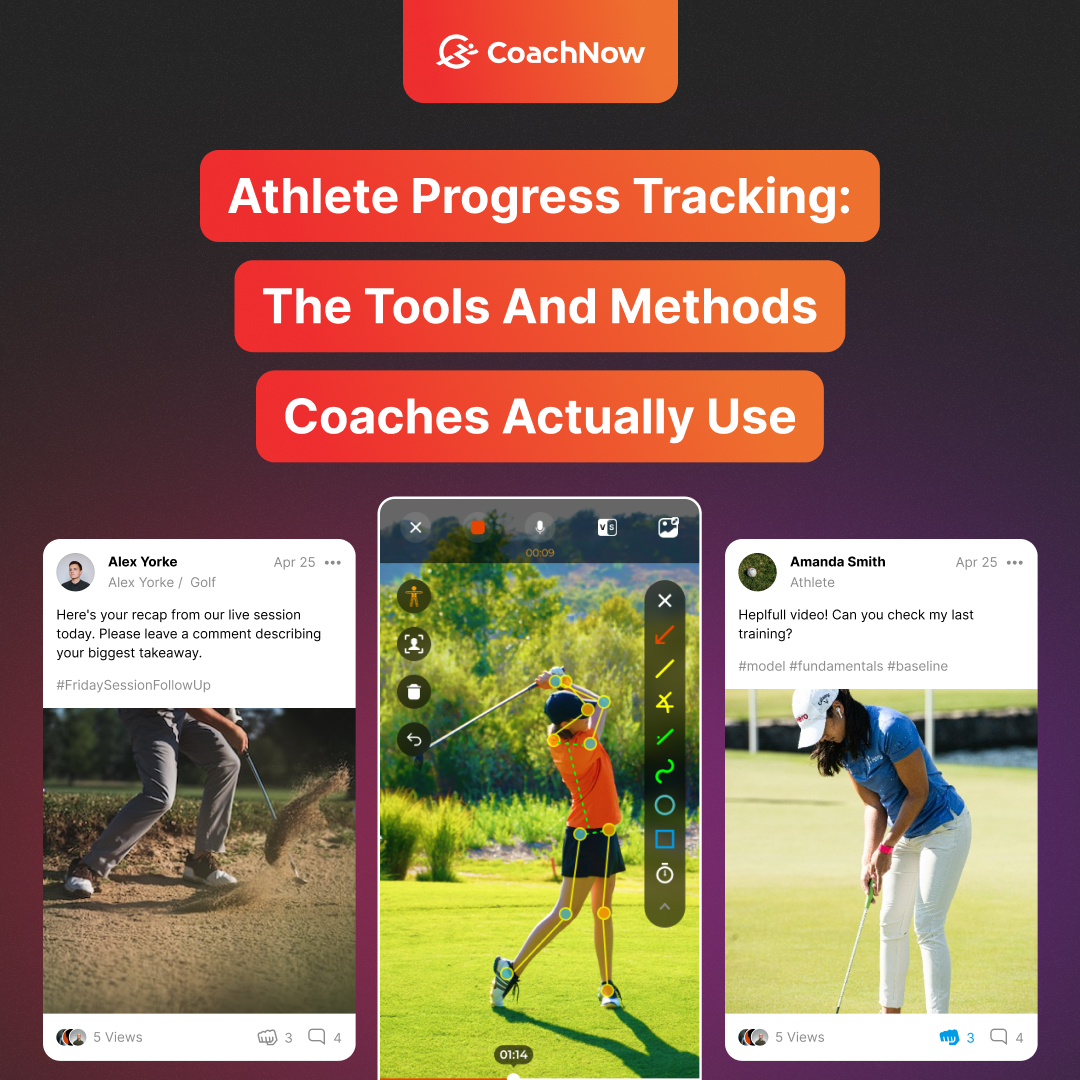
Spaces give every athlete a dedicated, organized channel where all of their development lives in one place. Videos, feedback, session notes, and voice-overs are stored and easy to pull up.
Versus Mode turns your video library into a progress visualization tool. The improvement that was hard to feel becomes impossible to ignore.
Annotations and voice-over means your session feedback becomes a permanent record. Your athlete gets the coaching and can review it whenever they need to. You get a timestamped record of what was addressed, when, and how.
Frequent check-ins keep communication between sessions documented in one place so the context of your athlete's journey, including how they're feeling and what they're working on, is always available when you need it.
Together, these tools don't just help you track progress. They make tracking something that happens naturally as you coach.
Tracking isn't just about data. It's about taking athlete development seriously enough to document it.
It tells your athlete: your progress matters enough to keep a record of. It tells you: here's what's working, here's what isn't, and here's what to do next.
The coaches who track consistently make better decisions and know when to adapt training to best meet their athletes’ specific needs.
.jpg?width=1343&height=806&name=Athlete%20Progress%20Tracking%20(4).jpg)
FAQ
What is athlete progress tracking and why does it matter? Athlete progress tracking is the practice of documenting development over time through session notes, video, benchmarks, and athlete check-ins. It matters because improvement is hard to see without a record. Tracking makes progress visible, helps coaches make better programming decisions, and keeps athletes motivated when improvement feels invisible.
What are the best methods for tracking athlete progress? The most effective methods used by coaches are session notes after every practice, performance benchmarks measured consistently over time, video comparison across sessions, athlete self-reporting through regular check-ins, and scheduled progress reviews every four to six weeks. Used together, they give a complete picture of development.
How does video help with tracking athlete progress? Video captures what memory can't like the specific mechanics, technical patterns, and moments of breakthrough that define an athlete's development. Comparing clips over time makes progress undeniable in a way that verbal feedback alone can't achieve. It's the most powerful progress tracking tool most coaches are underusing.
How often should coaches review athlete progress? Session-level notes should happen after every practice. Formal progress reviews work well every four to six weeks. Regular athlete check-ins on confidence and physical readiness can happen more frequently, even just before sessions.
What do athletes want from progress tracking? Athletes consistently want to know where they stand. They want honest, specific feedback on what's improving and what still needs work. They want to see their progress, not just hear about it. Visual tools like video comparison are especially powerful because they make improvement concrete rather than abstract.
How does CoachNow support athlete progress tracking? CoachNow's Spaces organize every video, note, and piece of feedback in one place, accessible instantly, session after session. Versus Mode lets coaches compare clips across time to show athletes their own improvement. Annotation, voice-over, and messaging make feedback permanent and searchable rather than fleeting. Together, they turn progress tracking from an afterthought into a natural part of the coaching process.