
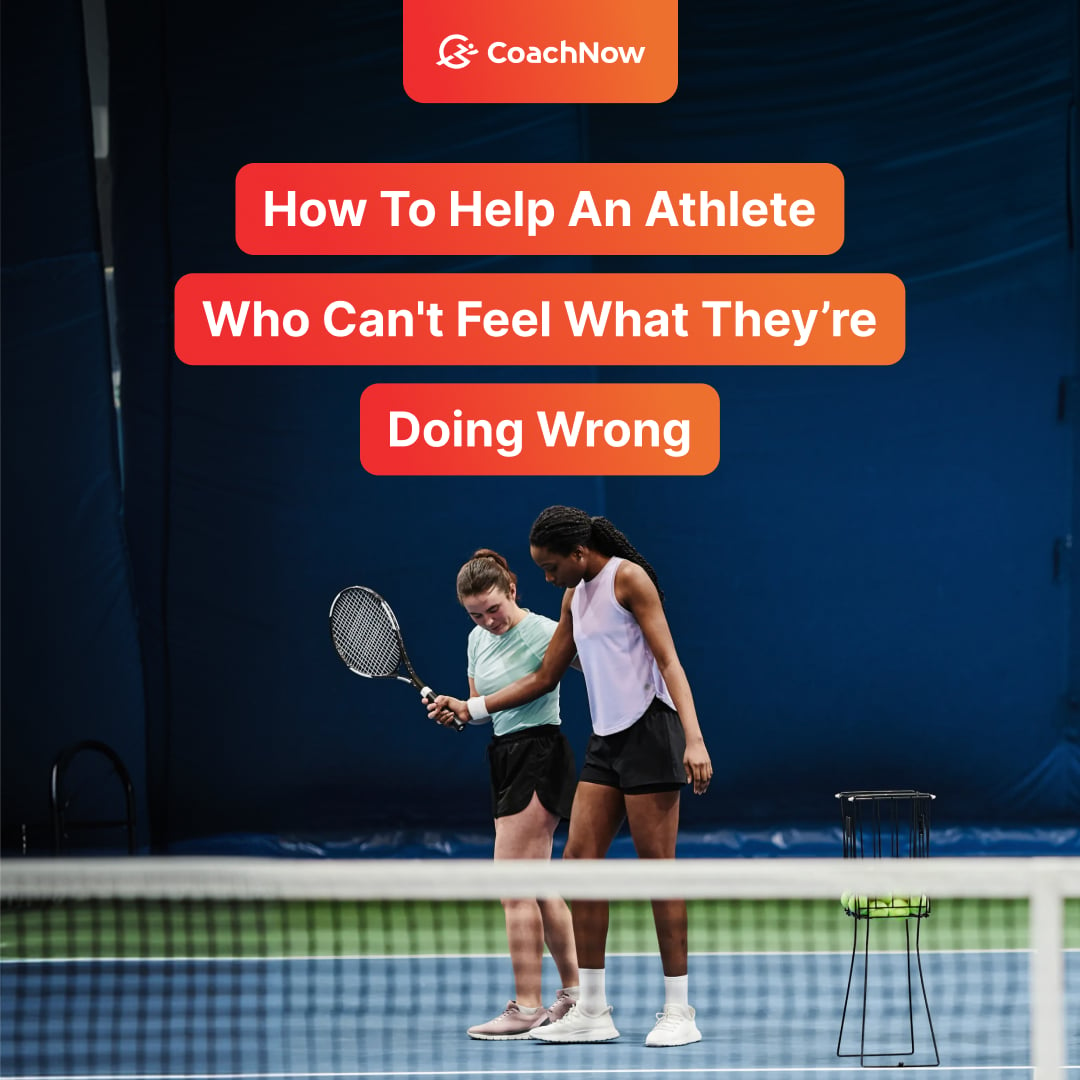
You've given the cue. You've explained it three different ways. Your athlete nods, tries again, and does the exact same thing.
They're not ignoring you. They're not being difficult. They genuinely can't feel the difference.
This is one of the most common, and most frustrating, situations in coaching. And it's more fixable than it seems, once you understand what's actually going on.
Let's dive in.
.jpg?width=1343&height=806&name=How%20to%20Help%20an%20Athlete%20Who%20Cant%20Feel%20What%20Theyre%20Doing%20Wrong%20(1).jpg)
Why Athletes Can't Always Feel What They're Doing
A movement pattern that's been practiced thousands of times doesn't feel wrong. It feels like the movement.
The athlete has no internal reference point for what different would feel like, because they've never consistently felt it.
This is the feel-vs-real gap AKA the difference between how an athlete perceives their movement and what it actually looks like. This gap can be vast, especially for beginners who lack the self-awareness or direction to know exactly what they should be improving.
In fact, one of the hallmarks of elite athletes is their ability to align feel and real. Often, professionals can pinpoint where they might have gone wrong without even viewing a playback.
Even then, the Pros still need to rely on video feedback to validate their feelings and to ensure their perception aligns closely with reality.
.jpg?width=1343&height=806&name=How%20to%20Help%20an%20Athlete%20Who%20Cant%20Feel%20What%20Theyre%20Doing%20Wrong%20(2).jpg)
What Doesn't Work
More verbal cues don't help. If an athlete can't feel their elbow dropping, explaining it five different ways doesn't close the gap. The issue isn't comprehension, it's actually feedback.
Repetition alone doesn't help either, since practicing a movement you can't feel correctly just solidifies the error even more.
.jpg?width=1343&height=806&name=How%20to%20Help%20an%20Athlete%20Who%20Cant%20Feel%20What%20Theyre%20Doing%20Wrong%20(3).jpg)
What Actually Works
Show them the movement, don't just describe it.
When an athlete can see exactly what their movement looks like, in slow motion and frame by frame, they have an external reference point that practicing without video can't provide.
CoachNow's slow-motion playback up to 240fps is built for this. Find the frame where the technique breaks down, pause it, and let your athlete see it. Most athletes immediately understand what you've been trying to describe. The cue finally makes sense because now it has a visual anchor.
Use skeleton tracking to make the invisible visible.
Sometimes slow motion alone isn't enough, especially for subtle joint position issues. CoachNow's AI-enabled skeleton tracking maps joint positions automatically, frame by frame, with exact angle readings and color-coded left/right tracking.
Instead of asking your athlete to spot the problem themselves, you can show them the exact degree measurement at the exact frame.
Give them a comparison, not just a correction.
Knowing what wrong looks like isn't enough. Athletes also need to see what right looks like, ideally in their own movement. Versus Mode lets you run a session from weeks ago where the movement was cleaner alongside today's footage. The athlete sees the difference directly, in their own body, doing two different things.
Keep it to one correction at a time.
Athletes working through blind spots are already under stress. Pick the one deviation that matters most, annotate the key frame, add a voice-over walking them through it, and send it to their Space in CoachNow to review before their next session. Progress on a single correction builds confidence, making future progress even easier.
The Bottom Line
Athletes who can't feel what they're doing wrong aren't failing. They need video analysis to help lead the way.
Your job is to give them the external feedback they can't get on their own. Video is the most direct way to do that. Once they can see it, they can start to feel it. And once they can feel it, they can fix it.
.jpg?width=1343&height=806&name=How%20to%20Help%20an%20Athlete%20Who%20Cant%20Feel%20What%20Theyre%20Doing%20Wrong%20(4).jpg)
FAQ
What is the feel-vs-real gap in sports coaching?
The feel-vs-real gap is the difference between how an athlete perceives their own movement and what it actually looks like. Often there is a large disconnect between when the athlete “feels” they are doing the right movement, though in reality they lack proper form. Video analysis is the most direct way to close this gap.
How do you correct an athlete who can't feel their technique errors?
Show them the movement rather than describing it. Slow-motion video gives athletes an external reference point proprioception can't provide. AI skeleton tracking adds exact joint angle measurements to make deviations concrete.
Side-by-side comparison of a correct rep versus an incorrect one helps athletes see what they're aiming for in their own movement.
Why do athlete technique errors persist even with coaching?
Technique errors persist when the feedback loop is incomplete. Verbal cues alone don't work if the athlete can't feel the error. Repetition without accurate feedback reinforces the error. The most effective interventions combine visual feedback like slow-motion footage, skeleton tracking, and side-by-side comparison, with focused practice on one correction at a time.